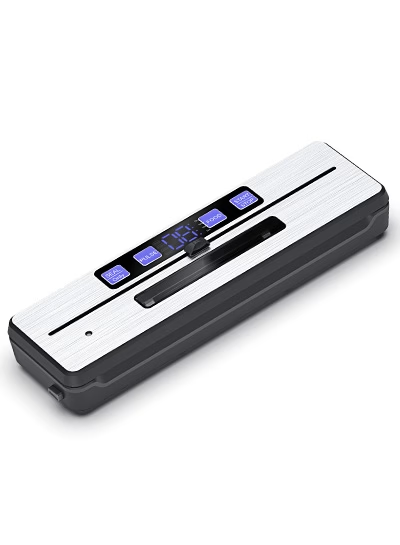
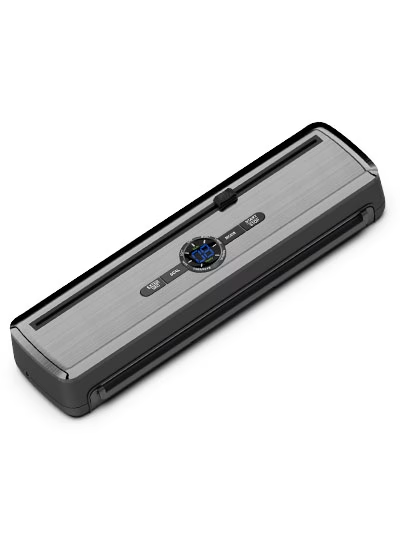
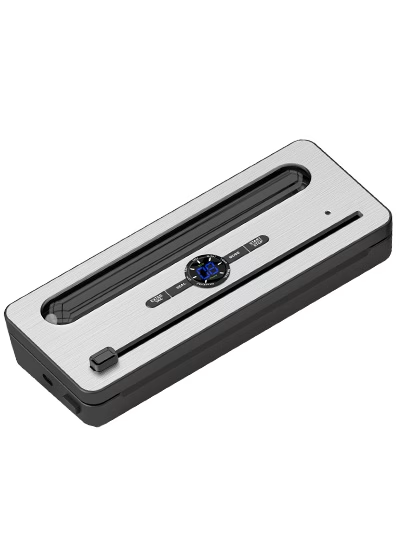
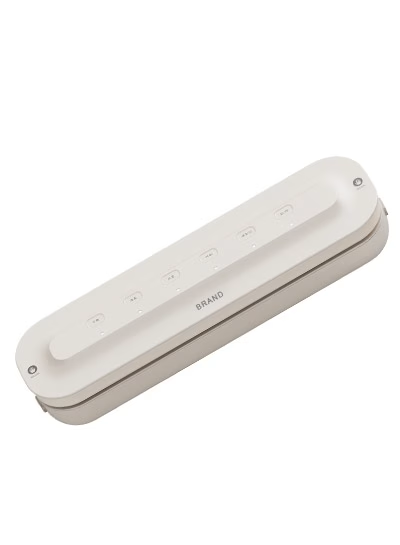
If you’re new to vacuum sealing or you’re evaluating equipment for a small business, you’ve probably heard the term “external suction sealer” thrown around. It describes one of the two main categories of vacuum sealing technology, and understanding it helps you choose the right machine and avoid expensive mistakes when buying bags.
The Basic Design
An external suction vacuum sealer (sometimes called a nozzle sealer, clamp sealer, or suction sealer) is a machine where the bag stays outside the main housing during the vacuum process. You place the open end of the bag into a clamping mechanism, and a suction nozzle or channel extracts air from inside the bag while it remains visible and accessible.
The entire vacuum and sealing operation happens at the bag opening, not inside a sealed chamber. The machine draws air out through that single point of contact.
How It Actually Works
Here’s the sequence: you place your product in a vacuum bag, insert the open end of the bag into the sealer’s clamping area, and close the lid or clamp. The machine activates a vacuum pump that pulls air from inside the bag through the suction nozzle. As air exits, atmospheric pressure compresses the bag walls around your product. Once the target vacuum level is reached (typically -60 to -80 kPa for external machines), the sealing wire heats up, melts the PE inner layer of the bag, and fuses the opening shut. After a brief cooling phase, the cycle completes.
The entire process usually takes 20-40 seconds depending on bag size and the machine’s pump capacity.
The Vacuum Level Reality
External sealers typically achieve -60 to -80 kPa (approximately 450-600 mmHg). That’s removing about 60-80% of the air from the bag, leaving residual oxygen around 6-8%.
For comparison, chamber vacuum sealers can reach -90 to -99 kPa, achieving near-perfect vacuum. The difference is real but often overstated for everyday food storage applications.
At -80 kPa, you’ve removed enough oxygen to slow aerobic bacteria dramatically. At -99 kPa, you’ve removed even more. For most food preservation use cases—especially home and small restaurant applications—the external sealer’s vacuum level is perfectly adequate.
The Embossed Bag Requirement
This is critical and often misunderstood: external suction sealers require embossed or textured vacuum bags.
Without embossing, the smooth inner surfaces of the bag collapse together when the machine tries to extract air. The suction can’t pull air from the far end of the bag because the walls are sealed shut against each other. You’ll end up with a puffy, barely-evacuated bag that defeats the purpose of vacuum sealing.
The embossed texture—the raised channel pattern—creates permanent micro-pathways that stay open under vacuum. Air can flow from anywhere inside the bag through these channels to the suction nozzle. Every external sealer on the market requires embossed bags for this reason.
This requirement has an upside: embossed bag rolls let you cut bags to any length you need. You can make an 8-inch bag or an 18-inch bag from the same roll, providing unlimited flexibility in bag sizing.
Where External Sealers Excel
External sealers are the dominant choice for:
- Home users: Affordable, compact, easy to use. Entry-level models start around $50-100.
- Small restaurants and caterers: Handle moderate daily volumes without the investment required for chamber machines.
- Occasional commercial use: When you’re not running hundreds of cycles per day, the lower bag cost and equipment cost make sense.
- Variable bag sizes: The roll format means you’re never locked into standard pre-made bag dimensions.
The Limitations
External sealers aren’t right for every application:
Lower vacuum levels: The -60 to -80 kPa ceiling means you can’t achieve the ultra-deep vacuum that chamber machines deliver. For some products, this matters.
Liquid management: When extracting air from moist foods, liquid can get pulled into the suction nozzle and pump. External sealers have a moisture problem that chamber machines avoid entirely. Using moist mode (if your machine has it) or freezing liquid items first are common workarounds.
Pump heat: Under continuous use, the pump generates heat. Most consumer and light commercial external sealers need rest periods between cycles to prevent overheating. This limits throughput for high-volume operations.
Bag size constraints: Very large bags are difficult for external sealers to evacuate fully. The suction path from the far end of a very large bag is long, and the pump may not have enough capacity to reach full vacuum at the bag’s opposite end.
Common Specifications to Understand
When evaluating external sealers, these specs matter:
Vacuum pressure (kPa): Higher is better within the external sealer range. -80 kPa is strong for this category. Anything below -65 kPa is weak.
Pump type: Diaphragm pumps are common in consumer models. Rotary vane pumps in commercial units. Rotary vane generally delivers better performance and durability.
Sealing bar width: Determines the maximum bag width the machine can handle. Standard is 12 inches (305mm). Larger bars mean larger bags.
Duty cycle: How many consecutive cycles the machine can run before needing to cool down. Commercial units specify this; consumer models often don’t, meaning you figure it out by overheating.
Power consumption: Ranges from 100W for small consumer models to 1000W+ for heavy commercial units. Higher power generally correlates with stronger pumps and faster evacuation.
Bag Cost Comparison
One advantage of external sealers: bag costs tend to be lower for embossed rolls compared to chamber-compatible smooth bags of equivalent quality. The economics are complex, but in general, external sealer users can achieve good results with moderately priced embossed bags.
Chamber machine operators who use smooth bags often enjoy lower per-bag costs, but chamber machine purchase prices are significantly higher, so the total cost of ownership analysis depends on your volume and use pattern.
Maintenance Needs
External sealers require straightforward maintenance:
The suction nozzle and any filters should be cleaned periodically—food particles and moisture accumulate. The sealing bar’s Teflon tape needs replacement every few hundred cycles depending on use. The pump benefits from occasional oil checks if it’s an oil-lubricated model (more common in commercial units).
Compared to chamber machines, external sealers are generally easier to maintain because the mechanics are simpler and more accessible.
Is an External Sealer Right for You?
If your budget is under $1000, you typically seal fewer than 50 bags per day, you want bag size flexibility, and your primary goal is extending food shelf life for home or small business use—external is almost certainly the right choice. The technology is proven, the bags are affordable, and the machines are accessible.
If you need ultra-deep vacuum for specialty applications, run hundreds of cycles daily, or are sealing highly liquid-heavy products as a primary business function, the economics may shift toward a chamber machine despite the higher upfront investment.
For most people exploring vacuum sealing for the first time, an external machine is the sensible starting point. You can always upgrade to chamber technology later if your needs evolve.